
GCE A Level Computer Science Paper 2 – Ngahtech Mock 1
- Examen
- Cameroon GCE Board
- Année
- 2026 · Mock 1
- Niveau
- Upper Sixth
- Durée
- 180 min
- points
- 100
Source: Original Ngahtech mock paper for GCE A Level Computer Science Paper 2. Not an official GCE Board paper.
Composez cette épreuve en mode entraînement ou chronométré : à la fin, vous obtenez votre note et le corrigé complet avec une explication pour chaque question.
Answer all five questions. Each question carries 20 marks; the marks for each part are shown.
- Show your working in calculations and trace tables.
- Draw diagrams in pencil where they are asked for.
- You have 3 hours.
After you submit, compare your answers with the marking scheme and give yourself marks, or ask a teacher to mark them.
- Question 1(a)Structurée4 points⏱ Temps conseillé : 7 min
A computer stores real numbers in 8 bits: a 5-bit mantissa followed by a 3-bit exponent, both in two's complement, with the binary point after the first bit of the mantissa.
Find the denary value of 01011\,011. Show your working.
- Question 1(b)Structurée4 points⏱ Temps conseillé : 7 min
Using the same format, give the normalised representation of -0.375. State how you know that your answer is normalised.
- Question 1(c)Structurée6 points⏱ Temps conseillé : 11 min
State the purpose of each of these registers: program counter, memory address register, memory data register, current instruction register, accumulator, status register.
- Question 1(d)Structurée6 points⏱ Temps conseillé : 11 min
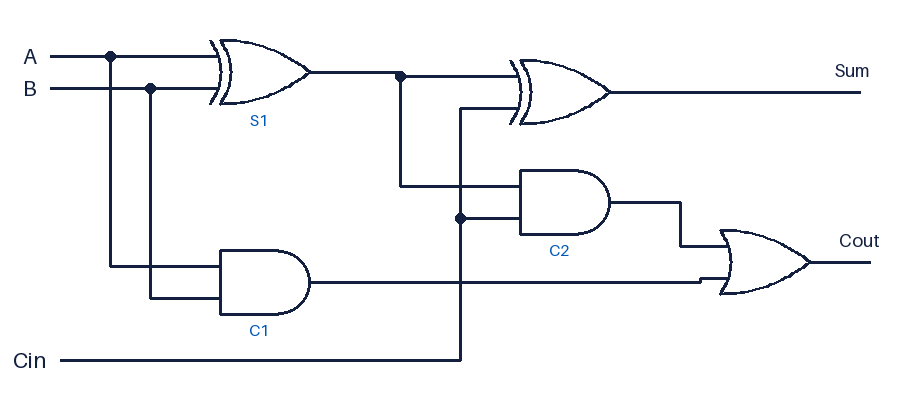
Figure 1 shows a full adder. 1. Complete its truth table for inputs A, B and Cin, giving Sum and Cout. 2. Explain how several full adders can be joined to add two 4-bit numbers.
- Question 2(a)Structurée5 points⏱ Temps conseillé : 9 min
Two booking clerks sell seats for the same bus at the same time from different computers. Using this example, explain what is meant by a race condition.
- Question 2(b)Structurée4 points⏱ Temps conseillé : 7 min
Explain how mutual exclusion prevents the problem in 2(a), and name one problem it can create.
- Question 2(c)Structurée6 points⏱ Temps conseillé : 11 min
Three processes arrive at time 0 in the order P1, P2, P3 with CPU burst times 5, 3 and 1 ms. 1. Draw a timeline for round robin scheduling with a time quantum of 2 ms. 2. Give the time at which each process finishes, and the average turnaround time.
- Question 2(d)Structurée5 points⏱ Temps conseillé : 9 min
- Distinguish between paging and segmentation.
- Explain how virtual memory lets a word processor and a spreadsheet run together when their combined size is larger than RAM.
- Question 3(a)Structurée4 points⏱ Temps conseillé : 7 min
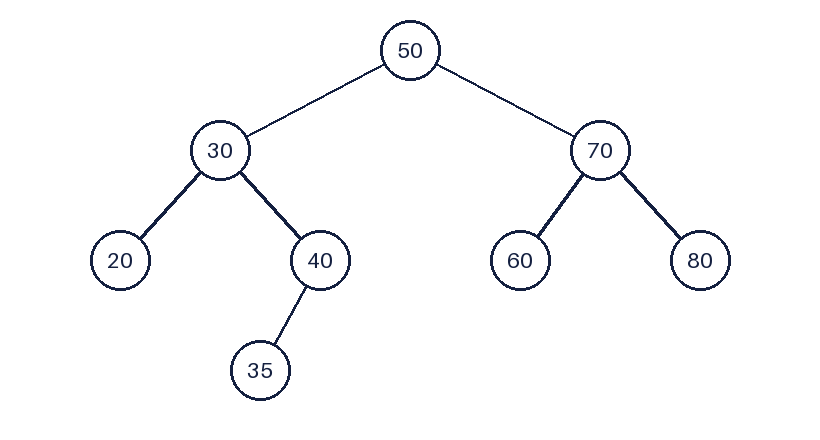
Figure 2 shows a binary search tree. 1. Give the order in which the keys were most probably inserted for the root to be 50. 2. Write the in-order and pre-order traversals.
- Question 3(b)Structurée4 points⏱ Temps conseillé : 7 min
Describe, step by step, how the key 65 is inserted into the tree in Figure 2, and state the number of comparisons needed to search for 35.
- Question 3(c)Structurée4 points⏱ Temps conseillé : 7 min
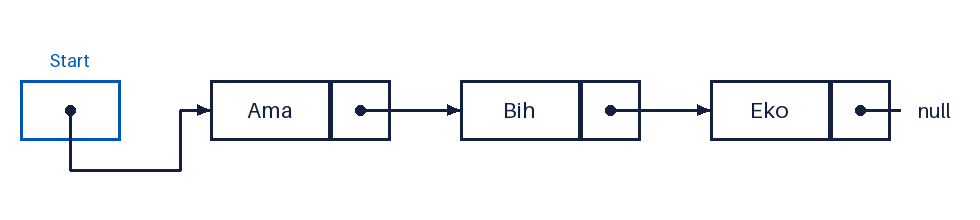
Figure 3 shows a linked list kept in alphabetical order. Describe how the name Bate is inserted, and explain why a linked list is better than an array for this.
- Question 3(d)Structurée8 points⏱ Temps conseillé : 14 min
Study the flowchart in Figure 4. 1. Dry-run it with A = 84 and B = 36, showing A, B and R after each pass. 2. State what the algorithm computes. 3. Write it as a recursive function
G(A, B).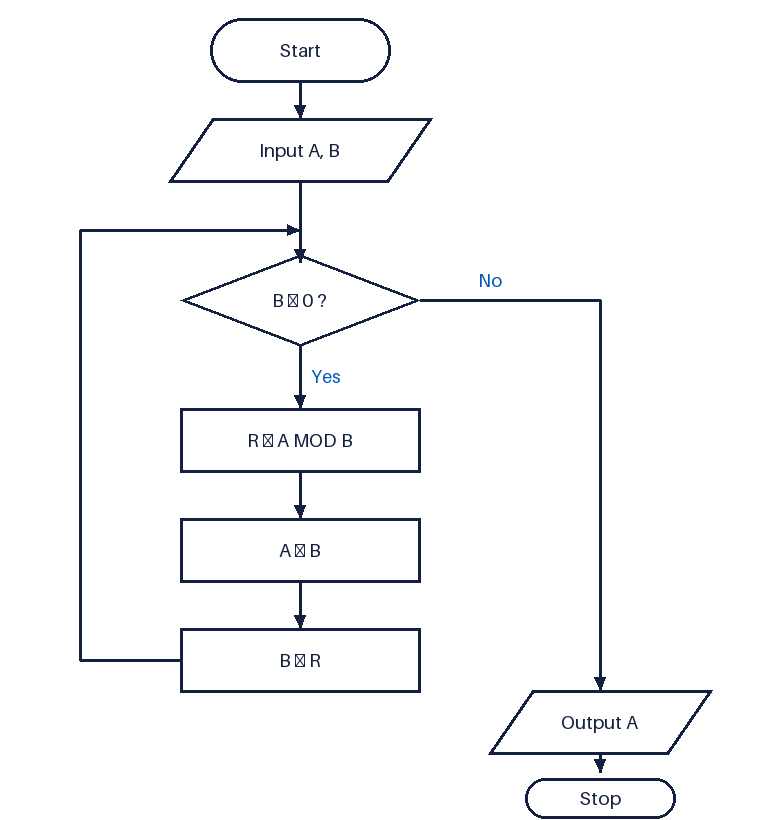
- Question 4(a)Structurée6 points⏱ Temps conseillé : 11 min
A school stores results in one table:
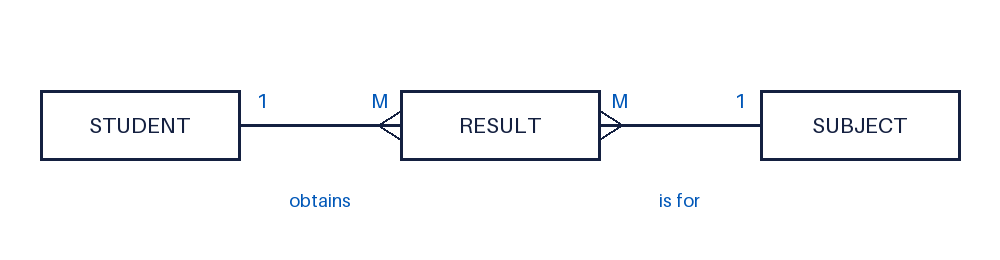
RESULT(StudentID, StudentName, Class, SubjectCode, SubjectName, Teacher, Mark)
A student takes many subjects and each subject is taken by many students. Normalise the data to third normal form, showing the tables with their primary keys (underlined or in bold) and foreign keys.
- Question 4(b)Structurée2 points⏱ Temps conseillé : 4 min
Figure 5 is an entity–relationship diagram for the tables in 4(a). Explain why the RESULT entity is needed.
- Question 4(c)Structurée6 points⏱ Temps conseillé : 11 min
Write SQL statements to: 1. list the names of students in class "U6S" in alphabetical order; 2. show each subject code with its average mark; 3. change Mark to 15 for student "S120" in subject "CSC".
- Question 4(d)Structurée6 points⏱ Temps conseillé : 11 min
Explain the four ACID properties of database transactions, using a Mobile Money transfer as the example.
- Question 5(a)Structurée6 points⏱ Temps conseillé : 11 min
A hospital network links several buildings. Explain the purpose of each of these devices: router, switch, bridge.
- Question 5(b)Structurée6 points⏱ Temps conseillé : 11 min
- Name the four layers of the TCP/IP model and give one protocol used at each.
- Explain why data is divided into packets.
- Question 5(c)Structurée4 points⏱ Temps conseillé : 7 min
Explain how asymmetric (public-key) encryption lets a patient send test results securely to a doctor who has never shared a secret with them.
- Question 5(d)Structurée4 points⏱ Temps conseillé : 7 min
Distinguish between a transaction processing system and a management information system, giving an example of each in a hospital.